
A Plea for Embodiment
Rediscovering the world-body connection and collective embodied wisdom.

My original intention for this second piece, as promised, was to begin investigating possibilities, practices and frameworks for Re-Integrating masculinity in our modern context.
But as it often goes, the piece had intentions of its own.
In the process of writing a brief summary, it was clear that something else desired to surface.
Rumblings from the deep.
A felt intuitive sense that moving towards “solutions” that reside solely on simplistic depictions of the state of men and gender dynamics will be insufficiently realistic or relatable and thus unable to generate meaningful change.
To ignore and look away would be naive and irresponsible.
The stakes are simply too high.
As I pulled the thread in front of me, the more granular details of the contextual web that masculinity and these gender dynamics rest upon revealed itself.
And so here we find ourselves…
My Dear Son,
In my last piece, I began to paint a picture of masculinity’s Dis-Integration in our modern context. Disconnection from body, brothers, the feminine, community, nature, and meaning has left us with nothing but a hollowed existence filled with shame, isolation, frustration, and confusion.
As Richard Reeves wrote in Of Boys and Men, “The typical man today is less educated, less employed, and less likely to be a father than his own father was.”
According to an analysis from the Institute for Family Studies, young men who grow up without their biological fathers are more likely to end up in jail or prison by their early thirties than to earn a college degree. They are also twice as likely to be unemployed and less likely to form stable families of their own.
Reeves observes that “many men are simply adrift, without purpose or direction.”
Warren Farrell adds a crucial layer of insight: “The boy crisis resides where dads do not reside.” Importantly, Farrell is clear that this isn’t an indictment of single mothers, who, as he notes, are “often doing hero’s work.” The problem is that when boys grow up without consistent access to masculine role models, they often miss out on the specific developmental lessons fathers tend to provide: lessons around boundaries, competition, and delayed gratification.
In The Boy Crisis, Farrell describes how a father’s roughhousing teaches boys to balance strength with restraint … to test limits safely and develop empathy through physical feedback. It’s in those moments of wrestling and challenge that a boy learns how to use his power without losing control.
Farrell writes that “when boys are deprived of their dad’s boundary enforcement, they often become addicted to immediate gratification.” Without that balance of masculine structure and feminine nurturance, many boys struggle to regulate themselves, turning instead to screens, substances, and stimulation to fill the void.
As Colin Wilson warned, “The modern man is alienated from his body, his instincts, and his natural vitality.”
He becomes an easy target for dopamine hijacking via super-physiological stimulation.
Something of which we have no shortage.
Algorithms learn his desires and insecurities and feed them back as short hits of novelty. Social media, pornography, video games, and streaming platforms all give him the illusion of achievement without action or physical effort.
Life is hard.
But thanks to modern technology he can now experience pseudo friendship, sex, camaraderie, achievement and endless entertainment without leaving the safety of his own home (or chair for that matter). With advancements in AI, neural link and virtual reality moving at a pace we aren’t equipped to fully comprehend, existing in the digital realms will only get more seductive.
What the hell do I need this damn body for anymore?

The average man now spends more than six hours per day in front of a screen, and as former Google ethicist Tristan Harris said, “Social platforms are designed to maximise engagement, not wellbeing.”
Processed foods, energy drinks, vapes, drugs, and alcohol are engineered to override the body’s natural reward system and disconnect him further from himself, blunting his instincts and intuition.
Ultra-processed foods alone now make up roughly half to two-thirds of total calorie intake across most Western countries. The food industry, to paraphrase author Michael Moss, has become the modern alchemist, turning salt, sugar, and fat into profit.
And with the mere touch of button he can have it all delivered to his doorstep in an instant.
Consumerism, the next purchase, the new drop, the next upgrade, a bigger house, a better car, the newest iPhone, another promotion.
The average person is now exposed to an estimated five to ten thousand ads a day, a constant low-grade assault on attention and desire.
It has become the religion of instant gratification dressed as self-expression.
Each of these industries is built on the same equation: “pleasure” equals profit.
The faster it can be delivered, with less effort from the consumer, the greater the spoils (convenience + comfort + pleasure = $$$).
Their success depends on disembodiment.
Conveniently, that’s also what they’re selling.
This isn’t merely coincidence.
It’s a symptom of the deeper meaning crisis we must face together, both men and women.
Crisis? What crisis?
It should be no surprise that if we place growth at literally any cost1 as our guiding value, we get… well…
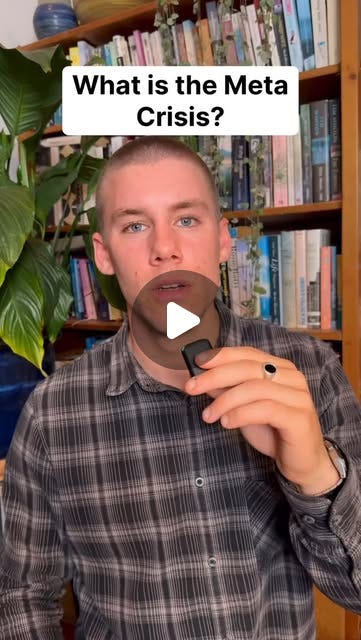
Jonathon Rowson dives into the deeper nuances of the Metacrisis2 here.
To put things bluntly, we’re quite literally soaking our food (and consequently the surrounding soil, rivers, oceans and airways) in poison to kill off any life form that goes near it, to then continue to eat it ourselves, believing we will be left unaffected.3
In 2020, researchers estimated that more than 350,000 synthetic chemicals are now in global circulation, most of which have never been tested for long-term safety.
Micro plastics have been found in blood, placentas, breast milk, testes, and even the human brain.
Heavy metals such as lead, cadmium, and mercury now appear in soil, drinking water, seafood, house dust, and infant formula, with no practical way to eliminate them from the environment.
Pesticide residues show up in over 70 percent of conventionally grown produce, and glyphosate is so pervasive that it has been detected in rainwater samples and even in the urine of more than 80 percent of adults and children tested.
The biological fallout is already visible.
Male sperm counts have dropped by more than 50 percent since the 1970s, female infertility is rising across all industrialised nations, and endocrine-disrupting chemicals like PFAS are now detectable in nearly every human on Earth.
The oceans contain five trillion pieces of plastic, and over 90 percent of fish species show contamination from industrial compounds.
The sobering truth is that this barely scratches the surface.
Over one million species face extinction (of the species we know).
Insect populations have crashed by 70–75% in many regions.
The oceans now contain 400+ hypoxic dead zones, areas so depleted of oxygen that fish, shellfish, and most marine life cannot survive.
Ecosystems are crossing irreversible thresholds.
We are erasing the biological foundations of our world.
We have become so out of touch with reality that we believe our world and our bodies to be separate entities.
“Will you teach your children what we have taught our children? That the earth is our mother? What befalls the earth befalls all the sons of the earth.
This we know the earth does not belong to man, man belongs to the earth. All things are connected like the blood that unites us all. Man did not weave the web of life, he is merely a strand in it. Whatever he does to the web, he does to himself.”
Our internal ecosystem mirrors the external ecosystem.
As forests thin, soils degrade, and species vanish, so too does the diversity of the microbiome that co-evolved with us.
The same forces driving mass extinction outside us are driving microbial extinction within us.
The devastation reaches far beyond what the eye can see.
There are an estimated one trillion microbial species on Earth, yet less than one percent have ever been named, and most gut microbes cannot even be cultured with current technology. Our sequencing tools capture only fragments of genetic material, and even the world’s largest data systems are too small to store or compare the full diversity of microbiome samples.
These microbes are disappearing faster than we can identify them, silently going extinct as antibiotics, pesticides, processed foods and industrial chemicals reshape our internal ecosystem.
What happens when we lose the microbial species we co-evolved alongside for our entire existence… you know… the organisms shown to regulate our immunity, metabolism, hormones, mood, inflammation, detoxification, gene expression, and even the development of our brain?
Is it starting to sink in?
“We suffer from a hallucination, from a false and distorted sensation of our own existence as living organisms. Most of us have the sensation that “I myself” is a separate center of feeling and action, living inside and bounded by the physical body — a center which “confronts” an “external” world of people and things, making contact through the senses with a universe both alien and strange. Everyday figures of speech reflect this illusion. “I came into this world.” “You must face reality.” “The conquest of nature.”
This feeling of being lonely and very temporary visitors in the universe is in flat contradiction to everything known about man (and all other living organisms) in the sciences. We do not “come into” this world; we come out of it, as leaves from a tree. As the ocean “waves,” the universe “peoples.” Every individual is an expression of the whole realm of nature, a unique action of the total universe. This fact is rarely, if ever, experienced by most individuals. Even those who know it to be true in theory do not sense or feel it, but continue to be aware of themselves as isolated “egos” inside bags of skin.”
And all of it is justified by “economic growth.”
In the name of “progress.”
Yet the US is $34 trillion in debt.
Global debt has surpassed $300 trillion.
Debt itself isn’t necessarily the issue; the problem is that our growth model requires perpetual extraction to sustain itself, even as the ecological foundation it draws from is collapsing.
We are poisoning ecosystems, sickening ourselves, and destabilising the future to service an economic story that counts destruction as progress and attempts to hide the “costs” off the balance sheet.
Does this sound like progress to you?
Have we gone mad?
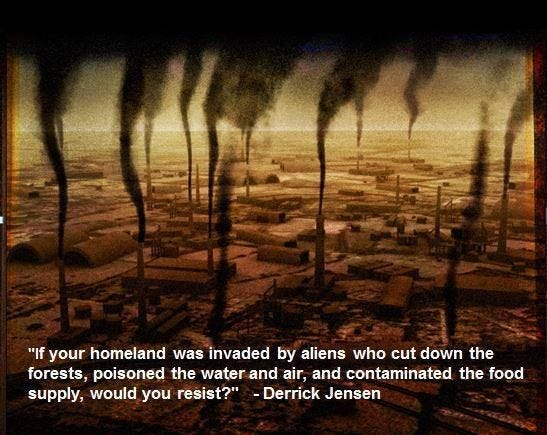
Facing this reality we find ourselves in demands strong, embodied men and women striving towards a unified truth.
That truth being the simple recognition that we cannot separate the health of our species from the health of the Earth, for we are but one and the same.4
Re-integration is not only personal, it’s planetary.
The health of our inner world will always mirror the health of the living Earth of which we are an irreducible expression.
“We often forget that WE ARE NATURE. Nature is not something separate from us. So when we say that we have lost our connection to nature, we have lost our connection to ourselves.”
Time to start paying attention

As I alluded to earlier in the piece, what makes these crises so seemingly omnipotent is the very life force and vitality we need to create real change is now the very thing feeding it.
Half a century ago, Herbert Simon predicted that an excess of information would lead to a poverty of attention. He was right. We now live in an attention economy. A system where human attention is the most valuable currency, traded, packaged, and sold to the highest bidder.
To reduce the definition of attention to simply “what you notice” is insufficient.
In psychology, it is usually defined as the process of selecting certain information while ignoring everything else. But that definition confines our understanding to the shallows.
What we choose to notice, and what we choose to ignore, becomes the architecture of our inner world.
Rob Burbea, in Seeing That Frees, writes that “the most fundamentally important fact about any experience is that it depends on the way of looking.” Our lives are shaped less by what happens to us and more by the lens we habitually bring to the world.
Through the “growth at all costs” lens, value collapses into a single dimension:
Output.
What cannot be monetised becomes invisible.
What cannot be scaled becomes irrelevant.
Human bodies become productivity tools, ecosystems become inventories, and attention becomes something to extract.
The lens flattens complexity and, in doing so, flattens us, leaving us unable to recognise the depth, meaning, and inherent worth that gives life its richness.
“We don’t see things as they are, we see them as we are.”
A different way of looking creates a different world.
Change the lens and the experience changes.
Change the experience and the self changes.
This is why our attention matters so deeply: it determines the lens, the lens shapes the world we perceive, and the world we perceive shapes the world we build.
Ian McGilchrist argues that attention is not just a mental habit; it is a moral act.
The way we pay attention shapes the world we experience.
Attention trains the nervous system. It sets the tone for our emotional world and the direction of our behaviour.
When attention is captured by digital distraction (now intentionally designed to be demonically captivating and addictive), it becomes narrow, self-centred, fragmented and weak. When captured by convenience and comfort, it becomes lethargic, passive and complicit.
When attention is grounded in the body instead of floating in the digital haze, it settles. It becomes steadier, clearer, more receptive. It widens. It attunes us to the people around us, to the natural world, to the quiet signals of intuition and meaning that cannot be accessed through the constant barrage of noise and stimulation.
It becomes a bridge back into intimacy.
Intimacy with ourselves, each other and the living world.
Intimacy with our reality.
Attention shapes who we become.
Whatever we repeatedly focus on strengthens certain patterns in us.
This is why McGilchrist says attention is moral: it reveals and reinforces what we value. The self is built from the inside out by the patterns of attention we cultivate.
The same is true at the cultural level.
What a society pays attention to ultimately becomes what that society creates.
A culture that fixates on excessive consumption produces excessive waste. A culture that fixates on hyper-stimulation produces hyper-addiction. A culture that fixates on speed to market leaves little space for the systems thinking required to understand consequences beyond the next quarter.
A culture that centres growth at all costs will incentivise psychopathic behaviours in individuals and corporations.
By contrast, a culture that gives attention to the living world produces stewardship, and a culture that gives attention to its own inner life produces wisdom.
This is why the attention economy is so pernicious.
It does not simply steal our time; it reshapes how we see the world and who we become inside it.
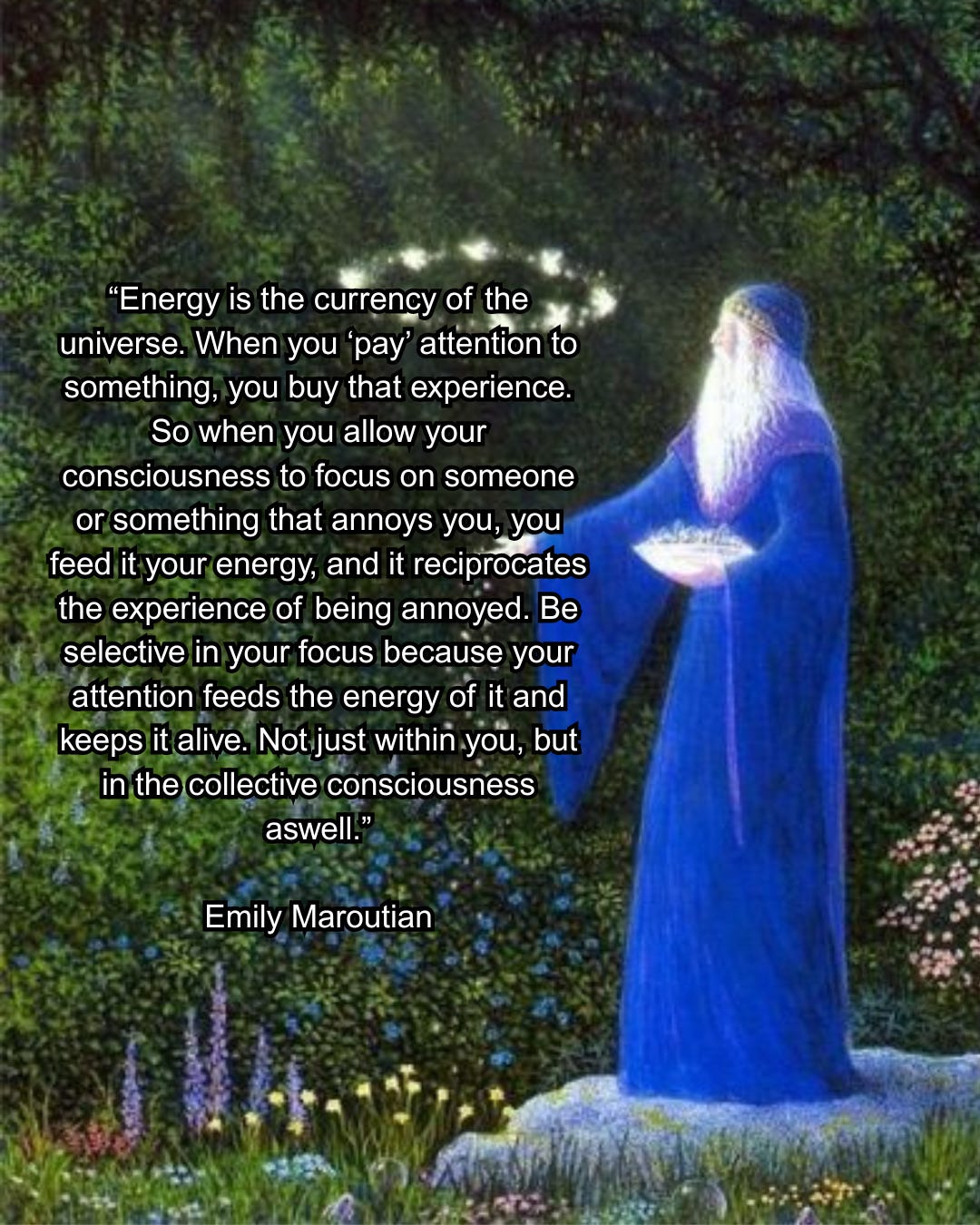
I’m sure you’ve heard the phrase “vote with your dollar.”
The idea is simple: money represents stored energy.
Where we spend it expresses what we value and the kind of world we support.
But in the attention economy, dollars are no longer the primary currency. Attention has become the more valuable form of energy.
Joseph Nguyen expands upon the common phrase, “Where your attention goes, energy flows. Where energy flows, things grow. What are you growing?”
What are WE growing?
In this sense, attention is never neutral.
It is a daily choice (admittedly a choice that is being seized by virtually everything around us) about what kind of world we bring into being.
It shapes the nervous system, the structural and subtle matter of our minds, the self, and the way we show up in the world.
And if you haven’t noticed, our attention energy is being harvested at a faster rate than any natural resource in history.
But just incase all of that wasn’t enough…
Are you familiar with the old story of the Sorcerer’s Apprentice?
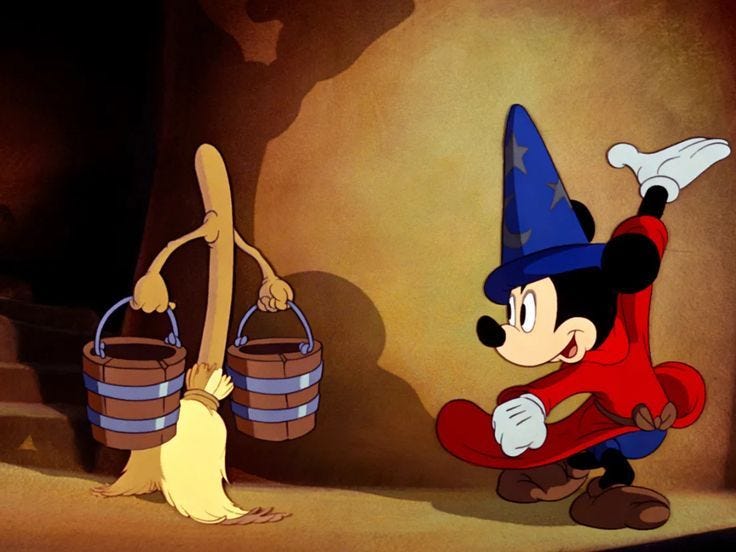
A young apprentice, left alone with access to magic he barely understands, casts a spell to animate a broom to fetch water for him.
At first it feels like genius.
A breakthrough, a shortcut, a promise of effortless progress.
But when the task is complete, the apprentice realises the broom cannot be stopped.
He hastily cast the spell without knowing how to reverse it.
The broom continues to carry water endlessly. Obeying the apprentice’s command without question.
Blind obedience.
The workshop floods.
Each attempt to fix the problem makes it worse.
In a panic, he chops the broom in half, only to watch each half rise as a new enchanted servant.
The broom multiplies, and his problems with it.
The lesson is timeless.
“The means by which we live have outdistanced the ends for which we live. Our scientific power has outrun our spiritual power. We have guided missiles and misguided men.”
Martin Luther King Jr., Strength to Love (1963) ch. 7
Like the apprentice, we have learned how to animate the broom without learning how to restrain its limits (full credit to the brilliant Josh Schrei for originally connecting these dots for me).
We now find ourselves in a global multipolar trap, hurdling towards Artificial General Intelligence.
Every nation and corporation is incentivised to accelerate. Slowing down risks falling behind. Falling behind could mean losing not only economic advantage but geopolitical security.
These incentives are not abstract.
Meta reportedly offered signing bonuses of up to $100 million to lure researchers from OpenAI, and has invested roughly $15 billion into ScaleAI to secure talent and data access. Industry-wide, senior AI researchers now command annual compensation packages in the $3–7 million range, with some deals exceeding $10 million.
Meanwhile, the dominant narrative among techno-optimists and trans-humanists is the belief that humanity can outrun its biological limits by merging with machines.
They argue that as long as consciousness can be uploaded, preserved, or integrated with artificial systems, the fate of the Earth becomes almost irrelevant. If we burn through the planet, we will simply “move on” into non-biological bodies, digital immortality, or off-world colonies (I think i’m gonna throw up).
Ray Kurzweil puts it plainly, “we will be able to upload the entire contents of our brain to a nonbiological substrate.”
And Sam Altman frames the trajectory even more starkly, “The merge has begun... Any version without a merge will have conflict: we enslave the A.I. or it enslaves us. The full-on crazy version of the merge is we get our brains uploaded into the cloud.”
No time for thought.
No time for consideration.
No time for restraint.
No time for wisdom.
It’s the same pattern that governs ecological collapse and cultural collapse.
The tragedy of the commons, playing out at the level of our shared capacity to make sense of the world.
This technological race does not exist outside the meaning crisis.
It’s fuelled by it.
A civilisation without restraint will sacrifice its future to its appetites.
Across nearly every ancient wisdom tradition, from Greek and Hebrew through to Taoist, Buddhist, Confucian, Hindu, and Indigenous teachings, restraint was seen as the signature of wisdom, while unchecked excess marked the beginning of folly.
And boy oh boy do we have a hell of a lot of unchecked excess.
Cultures separated by vast oceans and centuries arrived at the same insight: a human being who cannot govern himself cannot be trusted to act wisely in the world around him.
“If we continue to accumulate only power and not wisdom, we will surely destroy ourselves. Our very existence in that distant time requires that we will have changed our institutions and ourselves. How can I dare to guess about humans in the far future? It is, I think, only a matter of natural selection. If we become even slightly more violent, shortsighted, ignorant, and selfish than we are now, almost certainly we will have no future.”
Carl Sagan, Pale Blue Dot: A Vision of the Human Future in Space
Ok, that was a lot… Wait a second… Aren’t we meant to be talking about masculinity?
Quick recap:
When boys grow up without embodied masculine role models, they’re less likely to develop discipline, boundaries, or know how to regulate themselves (leaving them disconnected from their body, emotions and intuition).
The more disembodied, the more vulnerable to capture via instant gratification and the attention economy (leading to further disembodiment, a vicious downward spiral).
The consequences of captured attention goes far beyond distraction; it reshapes how we see the world, how we make sense of the world and ultimately how we shape it.
The growth imperative responsible for hijacking our attention also drives the poisoning of ecosystems, the erosion of meaning, and the multi-polar traps (e.g the AI arms race) pushing corporations, nations and individuals into acting out these psychopathic behaviours.
AI then becomes the final accelerant, a machine that amplifies disembodiment, cognitive atrophy, and the illusion that we can escape our biology and the Earth itself.
The result is a culture that pulls people out of their bodies, out of nature, and out of relationship with each other, all in the name of economic growth and “progress”.
So, it would seem, just as our fate as a species is inseparable from this Earth, from which we’ve evolved5, the masculinity crisis and Metacrisis are entangled in the same dance of meaning.
When we sever our connection to the body, our direct expression of the Earth, we inevitably lose the capacity to accurately value the world around us.
It’s no wonder we reduce a tree, a living being of unfathomable technical sophistication that we could only dream to design or replicate, to nothing more than the price of the timber we can extract from it.6
Reconnecting to the planet begins with reconnecting to the body.
Perhaps the essential first step in mending the world outside us is to reclaim the world within, to return to the collective embodied wisdom we have abandoned.
And for this we will need to take back our attention.
At the risk of sounding like a broken record, let’s drive this point home…
The brain consumes most of the body’s energy, therefore, the quality of our attention is inseparable from the quality of our physiology.
When the nervous system is inflamed, stressed, or stuck in a chronic fight-or-flight response, attention literally narrows. The visual field constricts, sensory input decreases, and awareness collapses onto whatever feels most immediate or threatening.
This is biology’s way of keeping us alive in danger, but when it becomes a default state, the world shrinks. We lose the ability to see beyond what’s directly in front of us, or the next perceived threat.
By contrast, a regulated, nourished, grounded body widens perception. The visual periphery opens, the nervous system softens, and the world becomes richer, more detailed, and more interconnected. Only in this state can we zoom out, hold complexity, and perceive the larger patterns shaping our lives.
And if this is true for an individual, it is even more true for a culture.
A society locked in collective stress and distraction develops the same tunnel vision as an inflamed nervous system. It becomes unable to step back, unable to recognise long-term consequences, unable to see the mess it is in.
We should not be surprised that a dysregulated civilisation produces a dysregulated reality.
Physiological health and vitality does not guarantee wisdom, but it certainly creates the conditions where it becomes more accessible.
Embodiment is the baseline for meaningful change because it restores the physical capacity for awareness, intimacy, discernment, and presence.
Before we can reshape culture or meet the crises around us, we must restore the health and energy that make attention, and therefore choice, possible.
All that is to say…
The responsibility, dear reader, lies with you
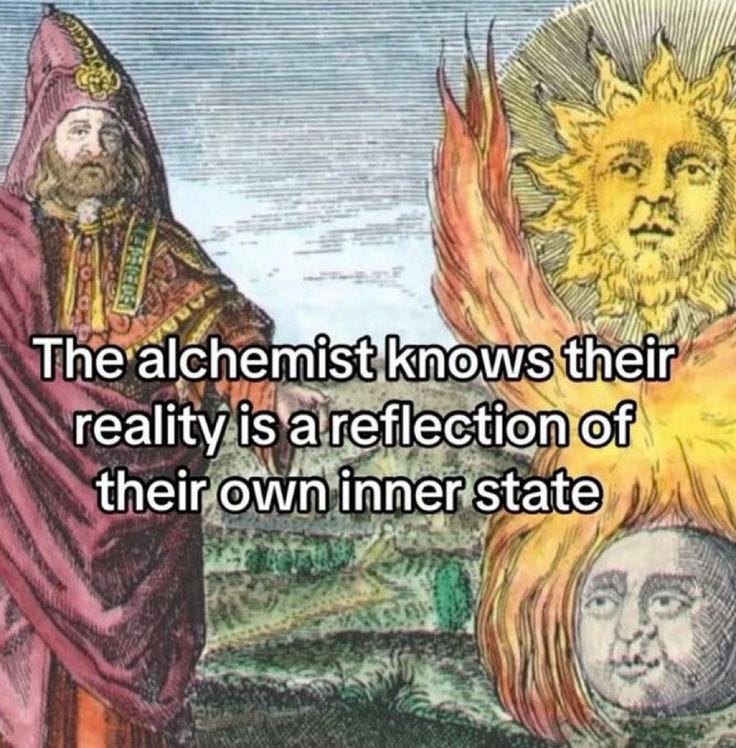
It begins with the individual.
A society cannot be more grounded, present, or embodied than the people who constitute it.
Collective individualism is the understanding that the collective can only transform through the individual. Not the hyper-individualism of “everyone for themselves,” and not the passive collectivism of “someone else will fix it,” but the recognition that every culture is built from millions of personal choices: where we place our attention, how we regulate ourselves, what we value, what we tolerate, and how we show up.
Real change is made possible when enough individuals reclaim their attention, their agency, their integrity, and their capacity to feel.
Real change begins within a person, but doesn’t end there; it ripples outward until it reshapes the whole.
The personal is the most directly accessible way for us to heal, which has an irreducible impact on the external world.
We simply cannot wait for the external world to heal first, precisely because we are the world.
I believe this leaves us with genuine hope.
The pieces to follow will be dedicated to the path of embodiment, investigating possibilities, practices and frameworks in hope of restoring our world-body union in service to generations to come.
E.g. the cost of the finite planet we inhabit, other species on said planet, our own species on said planet, even the health of ourselves, our children and anyone else we care about
The “Metacrisis” is a term used in systems philosophy to describe the interwoven ecological, economic, social, technological, and meaning-making breakdowns occurring simultaneously. Daniel Schmachtenberger expands this to include the “rivalrous dynamics” that drive ecological collapse, institutional decay, and exponential technological risk. John Vervaeke frames it as a “meaning crisis,” where modern individuals lose the capacity for relevance, belonging, and wisdom in a fragmented world. Zak Stein describes the Metacrisis as an “educational and developmental emergency,” where society lacks the psychological maturity needed to face global challenges. In essence, the Metacrisis points not to a single problem but to a failure of meaning, coordination, and collective wisdom across all domains of life.
Strongly recommend listening to this podcast, especially if you eat food or live on the planet Earth -
A fairly basic understanding of human biology makes this self-evident. The body evolved inside Earth-bound conditions; gravity, magnetic fields, circadian light cycles, microbial diversity, and the electrical grounding of the planet itself. When astronauts leave these forces for extended periods, their physiology begins to unravel. Research has documented widespread mitochondrial stress and immune dysregulation during spaceflight (Afshinnekoo et al., 2020), major down-regulation of mitochondrial proteins in ISS crews (Murgia et al., 2024), and profound circadian disruption due to the loss of natural day-night cycles (Zong et al., 2025). Tellingly, the best interventions or “solutions” we have for these problems are all attempts to mimic the Earth: artificial gravity, circadian lighting protocols, magnetic field simulators, grounding systems, and resistance-based loading. The closer these technologies recreate Earth’s original conditions, the better the physiological outcomes. In short: if you remove a human from the environment that imposed the demands of its evolution, the dependance is revealed.
In our current biological state.
A single mature tree is an engineering system of staggering complexity: billions of coordinated cells, vascular networks capable of hydraulic lift against gravity, symbiotic communication with fungi through mycorrhizal networks, atmospheric gas exchange, and sunlight-to-sugar conversion through quantum-scale photochemistry. Its root system stores information, its canopy regulates microclimates, and its presence supports entire ecosystems of insects, birds, and microbes. Despite centuries of biological research, no human-made technology even approaches the self-repairing, solar-powered, regenerative system that a tree represents.
Be the change you want to see
Ok so what’s next then!?